
Impact Stories: AgroServ Supports Innovation in Mycelium-Based Building Materials
2026, Sept 1
"We had the opportunity to collaborate and access the services provided by CIRM-CF, a MIRRI-ERIC partner, regarding the supply of fungal strains for our project MIMIC. The operations, assistance, and communications with them were always prompt and clear, and we are totally satisfied with the collaboration. It was crucial for our research exploring different methodologies to scale up the production of mycelium-based composite (MBC) building materials."
César Silva, PhD Student at Ben-Gurion University of the Negev
Developing more sustainable alternatives to conventional construction materials requires access to high-quality biological resources and specialised scientific services. Through the AgroServ project call for funded access to services, researchers at Ben-Gurion University of the Negev received the support needed to advance their work on mycelium-based composite (MBC) building materials, demonstrating how research infrastructures can accelerate innovation in sustainable construction.
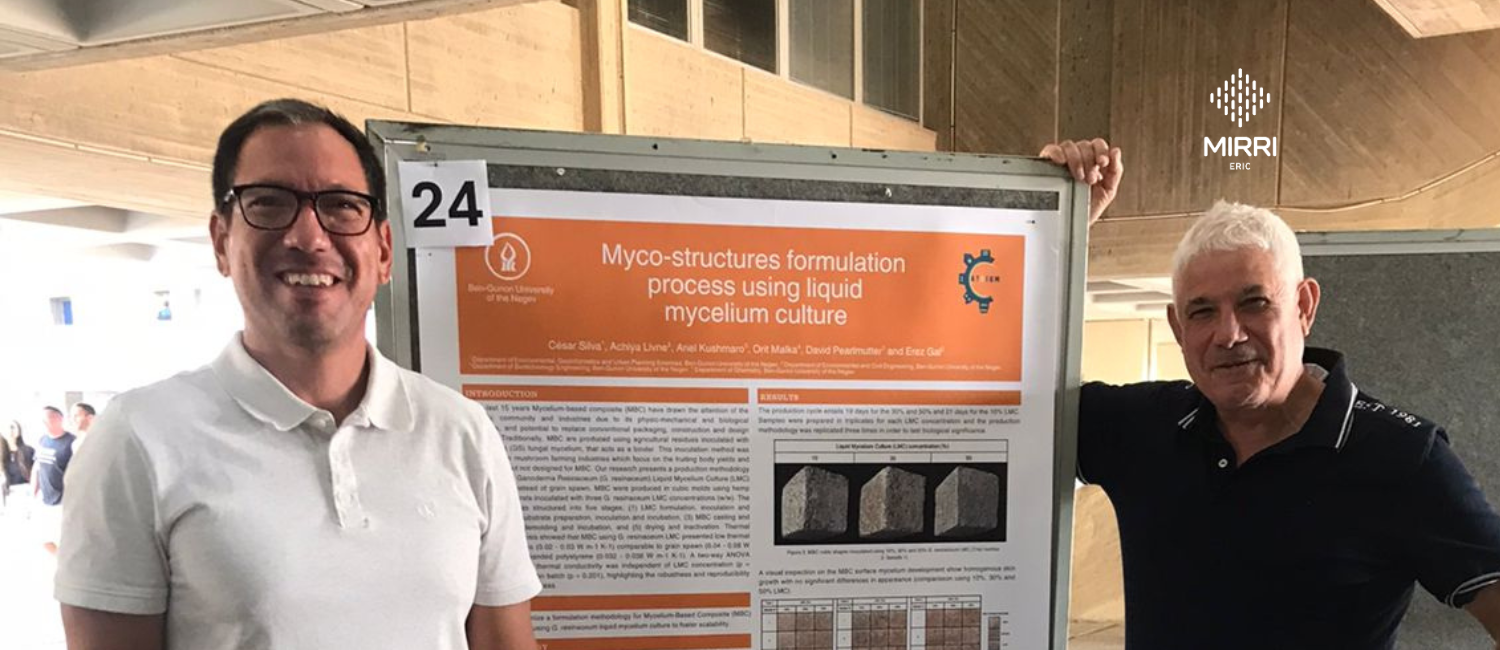
As part of the MIMIC project, PhD student César Silva (in the photo, on the left) identified CIRM-CF, a MIRRI-ERIC partner from the French National Node, through the AgroSERV project catalogue while searching for suitable fungal strains. Given the wide diversity of fungi available for mycelium-based materials, the collection provided expert recommendations on strains with the greatest potential for the project, helping the research team select promising candidates for further evaluation.
Beyond supplying the fungal strains, CIRM-CF provided continuous scientific and technical support throughout the collaboration. Questions related to strain selection, shipment conditions, contamination risks, storage requirements, and culture media were addressed "promptly", says the researcher, ensuring a smooth and efficient process. "The fungal strains were delivered rapidly and arrived in excellent condition, while additional material was also shipped to another project partner, with all logistics coordinated by the collection."
The research, conducted within the Department of Environmental, Geo-informatics and Urban Planning Sciences under the supervision of Erez Gal and David Pearlmutter, explores methodologies to scale up the production of mycelium-based composite (MBC) building materials. These bio-based materials have shown promising thermal insulation and acoustic properties, offering a potential alternative to conventional materials such as expanded polystyrene (EPS).
Although MBCs are traditionally produced using grain spawn (GS), this research project focuses on exploring the potential of liquid culture (LC) as an alternative inoculation method for large-scale production. "This is where the collaboration with AgroServ has been particularly valuable", states César Silva, providing services related to the supply of alternative fungal strains for evaluating growth rates, as well as imaging services to characterise the micro-morphology of fungal strains grown in liquid culture and within the resulting biocomposites.
The results of this collaboration will provide initial insights into how the micro-morphology of different fungal strains influences the mechanical performance of MBCs. Ultimately, these findings will contribute to expanding current knowledge on MBC formulation, characterisation, and production scale-up.
- Tags:
- Impact stories,
- Agroserv