
Impact stories: AgroServ Project in the Development of a Novel Biocontrol Formulation Against a fungal disease in cereals
2026, Jul 24
"My colleague Inmaculada Nistal and I made significant progress in developing and validating an innovative formulation of a biocontrol agent for the management of a fungal disease in cereals thanks to the AgroServ TNA 3rd call, which allowed us to access the Laboratory of Mycology from UCLouvain, from the Belgian node of MIRRI-ERIC."
Belén Guijarro Díaz Otero, researcher at INIA-CSIC (Spain)
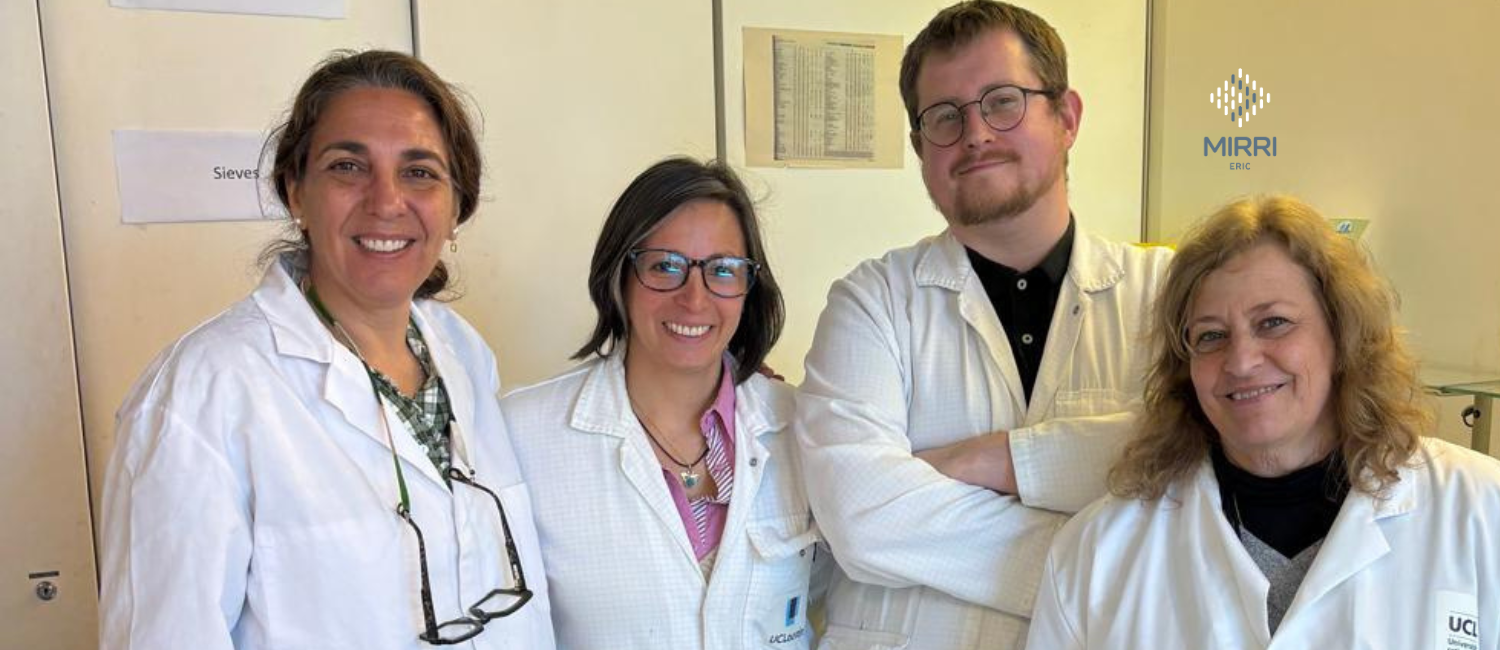
Within the framework of the AgroServ Transnational Access (TNA) Programme, the researchers Belén Guijarro Díaz Otero (on the left, in the photo) and Inmaculada Larena Nistal (on the right, in the photo), from the Plant Protection Department and the Plant Protection Products Unit of INIA-CSIC (Spain), in collaboration with the Laboratory of mycology from Université Catholique de Louvain (UCLouvain), from the Belgian node of MIRRI-ERIC and the Natural Resources Institute Finland (Luke, Finland), have made significant progress in the development and validation of an innovative formulation of the biocontrol agent Penicillium rubens strain 212 (PO212) for the management of Fusarium Head Blight (FHB) in cereals, a fungal disease.
The project, entitled "Enhancing Fusarium Head Blight Biocontrol in cereals: Optimisation of a pelletised Penicillium rubens PO212 Formulation", has been accepted in the 3rd TNA call. The project aims to improve the field performance of PO212 through the development of a pelletised formulation with enhanced stability and persistence. In parallel, it also seeks to evaluate the impact of the biocontrol treatment on reducing mycotoxin contamination in oat grain, contributing to improved food safety and sustainable crop protection.
During the visit to the MIRRI-ERIC partner UCLouvain, the first batches of pelletised PO212 formulations were successfully produced. The formulated product showed excellent performance, maintaining full viability after production and demonstrating its suitability for drying and long-term storage at room temperature. Sufficient material was produced to support the planned field trials during the 2026 growing season.
The project brings together complementary expertise and research infrastructures across Europe. The laboratory of mycology at UCLouvain is responsible for developing the pelletisation technology and formulation process. The Plant Protection Department of INIA-CSIC leads the project and oversees the production of the biocontrol agent and the assessment of its efficacy against FHB. There, it will also evaluate the treatment's effect on mycotoxin reduction in harvested grain. At the same time, with the help of Luke, the project will conduct field trials in Finland under different soil and environmental conditions.
Over the coming months, four field experiments will be established to assess the effectiveness of the pelletised formulation in reducing disease incidence, improving crop performance, and limiting the accumulation of Fusarium mycotoxins. These trials will provide us with essential data to support the future development and potential commercialisation of PO212 as a sustainable alternative to chemical fungicides.
The project exemplifies the objectives of the AgroServ project, in which MIRRI-ERIC is represented by BCCM-MUCL (from UCLouvain) and INRAE, by enabling transnational access to specialised research infrastructures and fostering collaboration between European partners with complementary expertise. By integrating formulation science, plant pathology, field validation, and food safety assessment, the consortium is contributing to the development of innovative biological solutions for resilient and sustainable agricultural systems.
- Tags:
- Impact stories,
- Agroserv