
MIRRI-ERIC and its community at the 44th ECCO Meeting in the Azores
2026, Oct 26
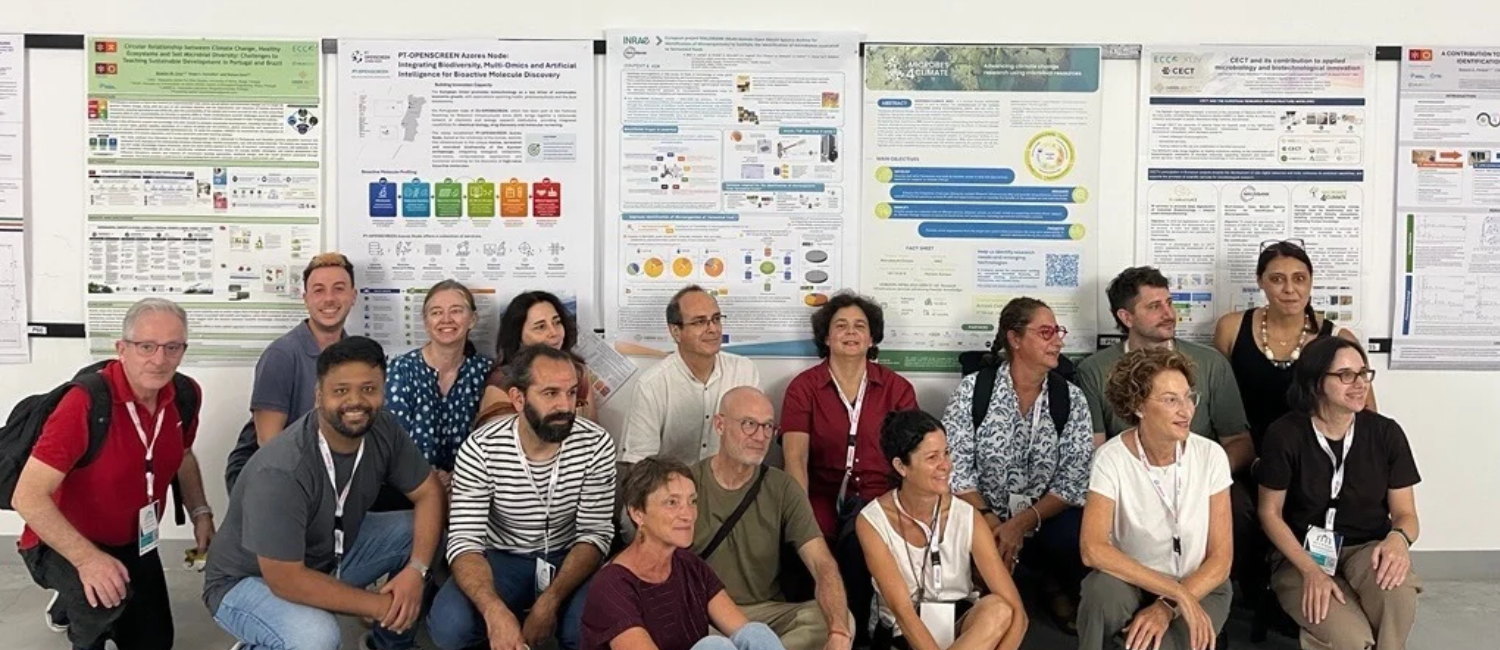
The 44th ECCO Meeting had a strong presence from MIRRI-ERIC and its community. The event took place from 14 to 16 September 2026 in Ponta Delgada (Azores, Portugal), and was hosted by BACA – Bank of Algae and Cyanobacteria of the Azores, an institution that works closely with MIRRI-ERIC. It brought together culture collections, researchers and research infrastructures from across Europe, and MIRRI-ERIC and its community were present throughout the programme.
On 16 September, MIRRI-ERIC's Executive Director, Ana Portugal Melo, presented "MIRRI-ERIC's Roadmap for FAIR Microbial Resources", which opened the session on Projects, Networks and Databases. The talk described how MIRRI-ERIC's status as an ESFRI Landmark and a European Research Infrastructure Consortium allows it to coordinate a distributed network of European culture collections and connect them with other research infrastructures. It also presented the Horizon Europe projects coordinated by MIRRI-ERIC: MIRRI-FIRM aims to consolidate and expand MIRRI-ERIC, strengthening its position as Europe's leading Research Infrastructure for microbial biodiversity; Microbes-4-Climate provides transnational access to resources and expertise for climate-related research; and Maldibank builds an open, FAIR archive of MALDI spectra for microbial identification, co-developed with industry.
The talk closed on MIRRI-ERIC's role in supporting EU biotechnology and bioeconomy policy, and on the importance of collaborating with networks such as ECCO.
Microbiome biobanking
Microbiome preservation was a recurring theme, and MIRRI-ERIC's community contributed to it in several ways:
- An oral presentation on how biological resource centres can adapt from preserving single strains to preserving complex microbiota was given by MIRRI-ERIC's partner French Collection for Plant-associated Bacteria (CIRM-CFBP) at INRAE, Angers (with Université d’Angers, Institut Agro and IRHS), together with CABI and the AIT Austrian Institute of Technology, within the MICROBE project, in which MIRRI-ERIC was involved together with other Research Infrastructures;
- An oral presentation and a poster, authored by several elements of MIRRI-IT, showed how the microbial communities of fermented Italian table olives can be preserved by cryopreservation and freeze-drying;
- A poster on microbial diversity and yeast typing in traditional sourdoughs from Villaurbana, in Sardinia, was presented by the University of Sassari (MBDS-UNISSCC culture collection), with CNR-ISA and INRAE/Université de Montpellier/Institut Agro, acknowledging MIRRI-IT.
National nodes and projec
The Spanish Type Culture Collection (CECT) at the University of Valencia, which hosts the Spanish node, MIRRI-ES, presented a poster on its contribution to applied microbiology and biotechnological innovation. It also presented one on the discriminatory power of MALDI-TOF MS in microbial taxonomy. The Czech Collection of Microorganisms (CCM) at Masaryk University, Brno, presented a poster on its status and prospects, highlighting its plans to establish a MIRRI-CZ consortium and joining MIRRI-ERIC.
MIRRI-ERIC partner Micoteca da Universidade do Minho (MUM) participated in the event with a poster celebrating its 30 years of existence.
Projects' highlight
Maldibank's main poster, presented by INRAE, focused on identifying the microbiota of fermented foods. Maldibank also featured in:
- an oral presentation from the University of Turin on MALDI-TOF MS identification in the Cladosporium cladosporioides species complex, held in the MUT collection;
- a poster from MUM and CIIMAR, University of Porto, on lipidomic-enhanced microbial identification using negative-ion MALDI-TOF MS;
- the poster celebrating 30 years of MUM;
- a poster on Rosellinia necatrix in western Portuguese orchards, by the University of Minho and INIAV;
- the CECT/University of Valencia posters mentioned above.
Microbes-4-Climate was presented in a poster by CECT/University of Valencia and MIRRI-ERIC, with AnaEE-ERIC, the Sociedade Portuguesa de Inovação (SPI) and the University of Turin. It described transnational access to four research infrastructures and 144 services across 20 countries.
Partners in the scientific programme
Aniket Saraf (Institut Pasteur) presented the hidden diversity of microcystin-producing cyanobacteria. Pedro Leão (CIIMAR, Portugal) gave a keynote on the discovery of unique cyanobacterial compounds. Federica Spina (University of Torino) spoke about fungal bioremediation of contaminants. Belén Baena (BEA, University of Las Palmas de Gran Canaria) presented the cyanobacterial potential of the Spanish Bank of Algae. Adil Ennaji (BCCM, Belgium) closed the session on ethical and legal challenges with an overview of the patent system for inventions using microorganisms.
MIRRI-ERIC thanks BACA and the organisers, and all partners who contributed to the programme.
